Attic & Cathedral Ceiling Spray Foam in Essex County
Cathedral ceilings, vaulted spaces, and problem attics — closed-cell foam where loose-fill can't do the job.
Standard attics with deep, open space are loose-fill territory. But the moment a roofline gets interesting — cathedral ceilings, vaults, low-slope sections, half-storeys, dormers — conventional insulation runs out of room and out of answers.
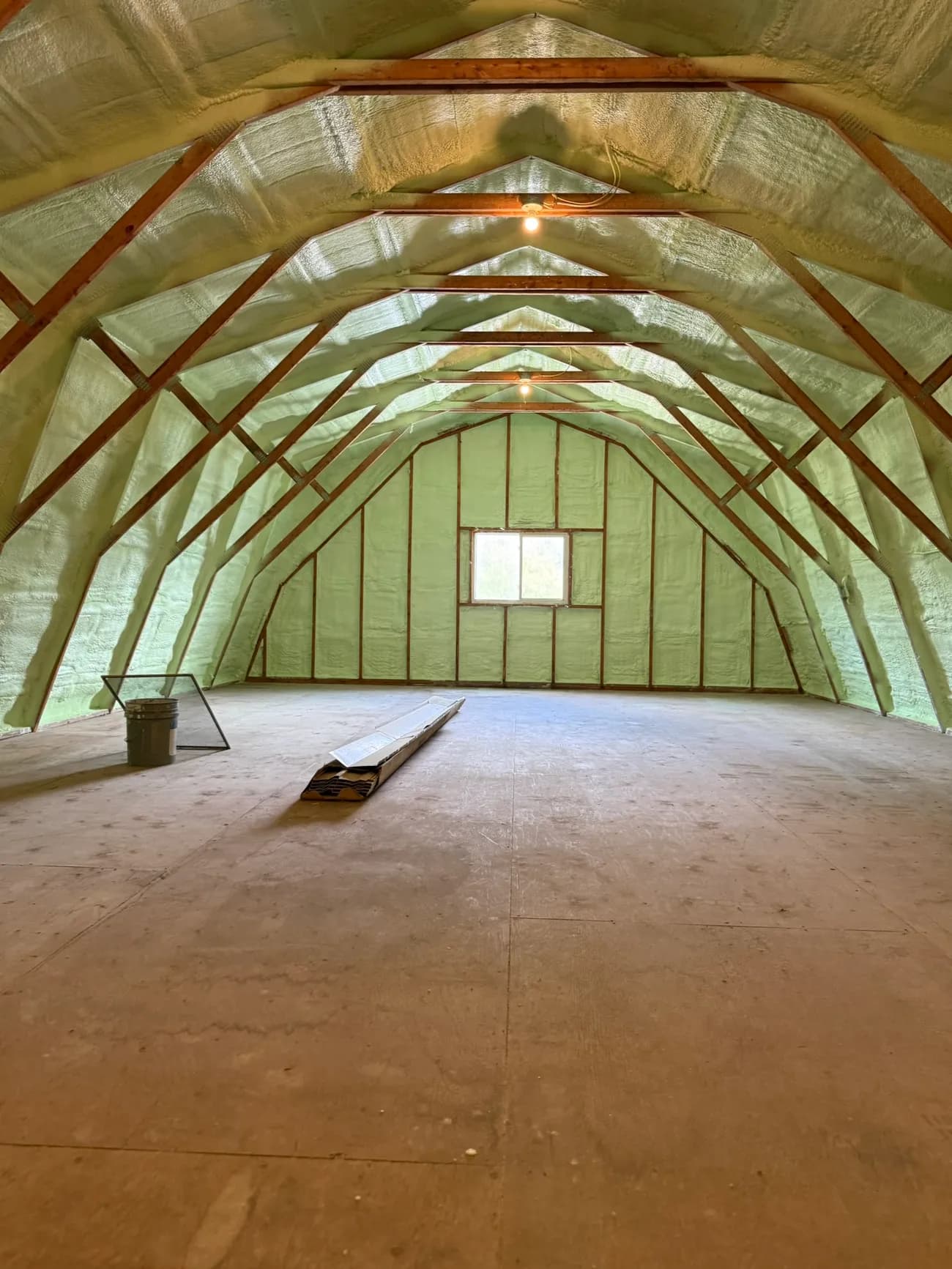
Cathedral assemblies give you rafter depth and nothing more. Batts in that depth can't reach code R-values and leave ventilation and condensation problems behind. Closed-cell foam at R-6 per inch hits high R-values in the depth available, air-seals the assembly, and controls vapour — the complete package in the one place there's no room for anything else.
We spray cathedral ceilings, vaulted additions, and problem attic assemblies across Essex County.
Served locally across Essex County — Leamington, Kingsville, Windsor, Lakeshore, Essex, and Chatham-Kent.
The Problem
Cathedral Ceilings Are Where Batts Give Up
A 2x8 rafter bay holds about R-20 of batt — under code for a ceiling, and that's before the batt slumps or the ventilation baffle collapses. Warm air leaking into the assembly condenses on the cold sheathing, and over years that means stained ceilings, ice dams, and rotten roof decks.
Ice dams are usually the visible symptom: heat escaping through a weak ceiling melts snow, which refreezes at the eaves. The fix isn't more shovelling — it's an assembly that doesn't leak heat.
Why It Works
What Foam Does in a Roofline
- R-6 per inch — real R-values within existing rafter depth
- Air-seals the assembly — the leak driving ice dams stops
- Vapour barrier built in — no condensation on the sheathing
- Unvented (hot roof) assemblies done correctly and to code
- Rigid, bonded, permanent — no slumping in sloped bays
- Quiet — foam-sealed rooflines noticeably dampen rain noise
FAQ
Common Questions
If the dams come from heat loss through the ceiling — and they usually do — yes. Sealing and insulating the roofline stops the melt-refreeze cycle at its source. We'll assess your roofline and tell you what's driving it.
Ready to get started?
Call (519) 324-6173