Ontario Building Code Compliance for Spray Foam
Material standards, certified installers, thermal barriers, and vapour control — what the OBC requires and how our documentation answers it.
Spray foam is one of the most regulated insulation products in Ontario — which protects you, if your contractor takes the regulation seriously. Every inspection pass we count started with compliance built into the scope, not negotiated on site.
The core requirements: medium-density closed-cell foam must meet CAN/ULC-S705.1 (the material standard) and be installed per CAN/ULC-S705.2 (the installation standard) by certified installers who verify conditions and document the application. Foam generally requires a thermal barrier separating it from occupied space — typically 12.7 mm drywall or an approved coating. And at sufficient thickness, closed-cell serves as its own code-recognized vapour barrier, which removes poly and its failure points from the assembly entirely.
This page is orientation, not legal advice — code details change with amendments and vary by assembly. What doesn't change: when we quote your project, compliance is specified in writing, and the documentation your inspector wants is part of the deliverable.
We mobilize anywhere in Ontario for projects at scale.
Why It Works
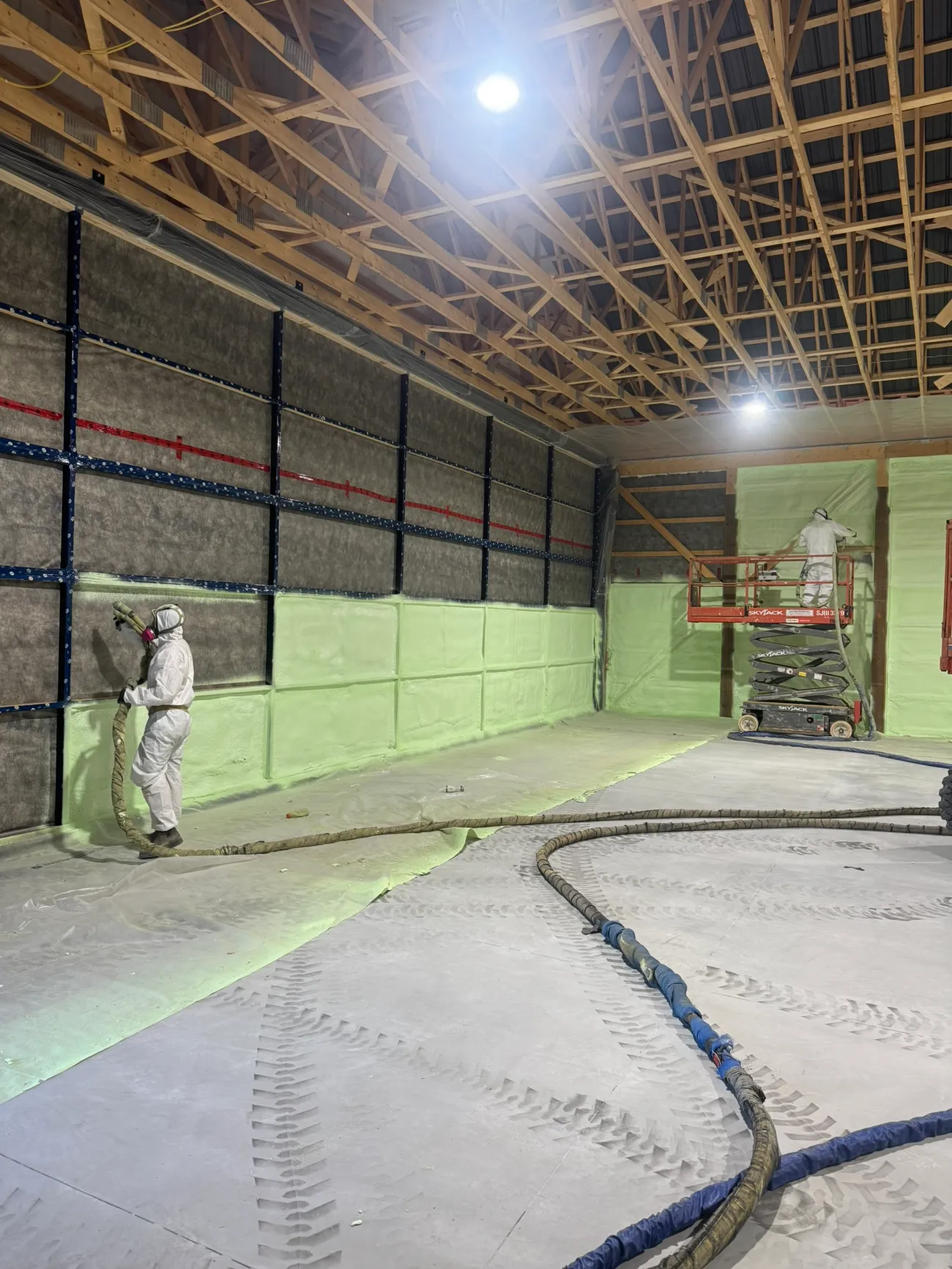
What Compliance Looks Like on Our Jobs
- Certified installers applying to CAN/ULC-S705.2 with daily work records
- Product documentation proving CAN/ULC-S705.1 compliance
- Thickness verified and spot-check records available on request
- Thermal barrier requirements flagged in the scope — never discovered at inspection
- Vapour barrier compliance by design at two inches
- Photo documentation pre- and post-application
FAQ
Common Questions
Yes — closed-cell foam at sufficient thickness (typically 50 mm) is a code-recognized vapour barrier. Inspectors across Essex County and Ontario see these assemblies constantly; our documentation confirms product and thickness so there's nothing to debate.
Ready to get started?
Call (519) 324-6173