Basement Spray Foam Insulation in Windsor & Essex County
Dry, warm, code-compliant basement walls with no poly and no mould risk. Most basements are a one-day job.
Finishing your basement? The insulation you choose before drywall decides whether the space stays dry and comfortable for decades or grows mould behind the studs.
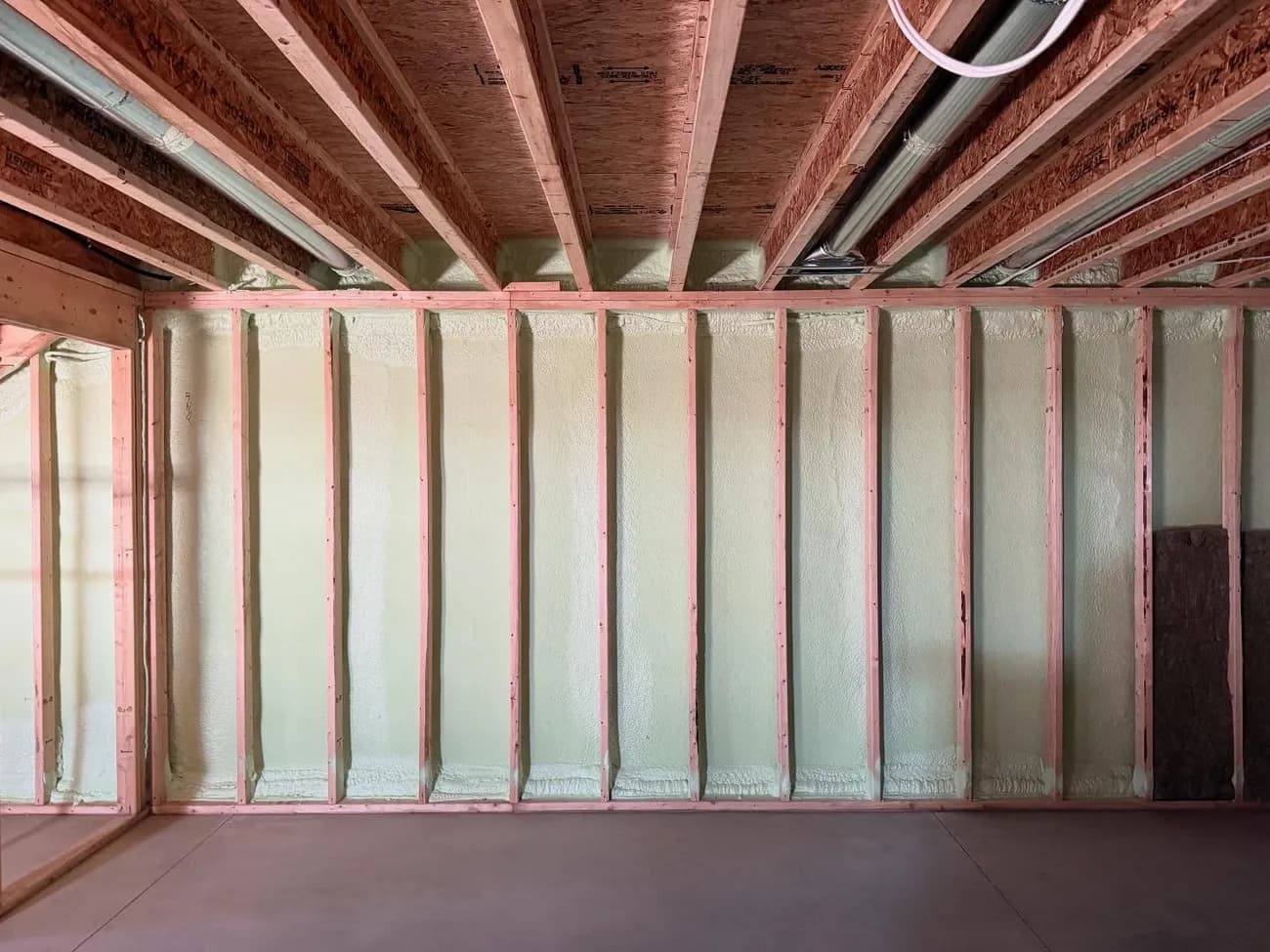
Concrete is a moisture reservoir — it wicks ground moisture and releases it inward year-round. Fibreglass and poly against concrete builds a condensation trap: the assembly behind that musty basement smell everyone recognizes. Closed-cell foam is the opposite: it bonds to the concrete, can't absorb water, and at two inches acts as its own code-compliant vapour barrier.
We spray basements across Windsor, Leamington, Kingsville, and the rest of Essex County — most are a single day on site.
Served locally across Essex County — Leamington, Kingsville, Windsor, Lakeshore, Essex, and Chatham-Kent.
The Problem
Fibreglass + Poly + Concrete = Mould
Moisture moving out of the foundation gets trapped between the concrete and the poly, condensing in the fibreglass. Wet batts lose their R-value, feed mould, and rot the framing — invisibly, behind the finished wall, until the smell or the health complaints show up.
Cold floors and drafts are the same wall failing thermally: air circulating behind poorly-fitted batts strips heat from the space no matter what the thermostat says.
Why It Works
The Right Basement Assembly
- Bonds directly to concrete — no air gap, no convection loop, no drafts
- Unaffected by moisture — can't absorb water, can't feed mould
- Two inches = code-compliant vapour barrier, no poly needed
- About R-12 at two inches, R-18 at three — thickness spec'd to your project's code path, no thick furring
- Seals the rim joist zone where basements leak most air
- Passes inspection with documentation — inspectors see foam basements daily
How It Works
One Day, Start to Finish
Step 1: Quote
Wall dimensions and a couple photos get you a fast quote.
Step 2: Prep
We mask, protect, and prep — the space is ready to spray in an hour or two.
Step 3: Spray
Closed-cell to spec on foundation walls and rim joists.
Step 4: Frame Away
Cured and ready — stud walls and drywall can proceed on schedule.
FAQ
Common Questions
Either works — foam can go on bare foundation walls before framing (our preference; fully continuous) or into framed cavities against the concrete. If you're planning the project, call before you frame and we'll help you sequence it.
Ready to get started?
Call (519) 324-6173